Guides
Build a Local RAG Pipeline That Actually Answers Questions
Design a local RAG stack with better retrieval, cleaner context, and fewer vague answers.
Build a Local RAG Pipeline That Actually Answers Questions
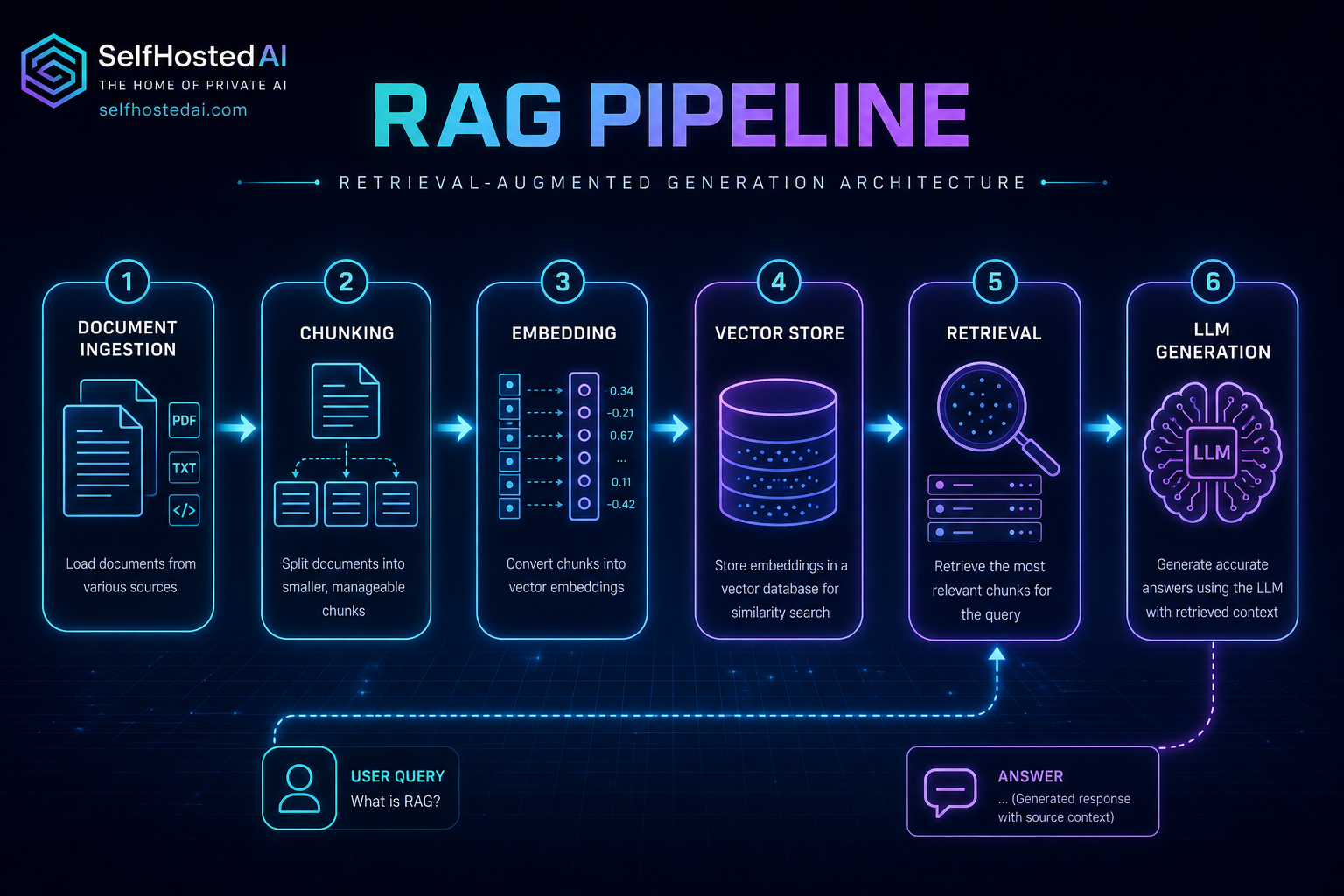
Retrieval-augmented generation is easy to describe and harder to make useful. The goal is not just to connect a vector database to a model. The goal is to answer real questions with enough evidence that users trust the result.
Start with the question you want to answer
Define the actual task before choosing tools. Do you want support staff to find policy answers, engineers to search incident notes, or a household to query manuals and receipts? The question determines your ingestion and ranking strategy.
If you need a baseline runtime first, read How to Run Llama 3 Locally with Ollama.
Build the retrieval layer first
Before you care about generation quality, make retrieval reliable. Chunk documents sensibly, attach useful metadata, and verify that the right passages appear in search results for your test queries.
Measure recall with a small test set
Use a few hand-written questions and check whether the top retrieved chunks contain the answer. This is often more important than testing the final answer text first.
Keep context compact
Overstuffed prompts lead to noisy answers. Pass only the chunks that matter, remove duplicates, and prefer concise source excerpts over giant context dumps.
For document-centric interface choices, compare Open WebUI vs AnythingLLM.
Evaluate answer quality
Check whether the model cites the right source, refuses unsupported claims, and says when it cannot find an answer. A useful RAG system is honest about uncertainty.
Conclusion
Local RAG works when retrieval is disciplined and the answer layer is constrained. Start small, test with real questions, and improve one stage at a time.
FAQ
Is more context always better?
No. Extra context can distract the model and reduce answer quality.
What matters most in RAG quality?
Chunking, retrieval recall, metadata, and prompt discipline usually matter more than fancy model changes.
Can I use RAG with plain text files?
Yes. Plain text, markdown, and well-extracted PDF text are all good starting points.


