Models
Phi-4: How Microsoft's Compact Model Changes Local AI Deployment
Run Phi-4 locally on modest hardware, understand why its small size punches above its weight, and integrate it into practical workflows.
Phi-4: How Microsoft's Compact Model Changes Local AI Deployment
Phi-4 represents a shift in what is possible with small models. Microsoft proved that careful data curation and training methodology can produce a model that competes with much larger alternatives while running comfortably on consumer hardware.
The small model thesis
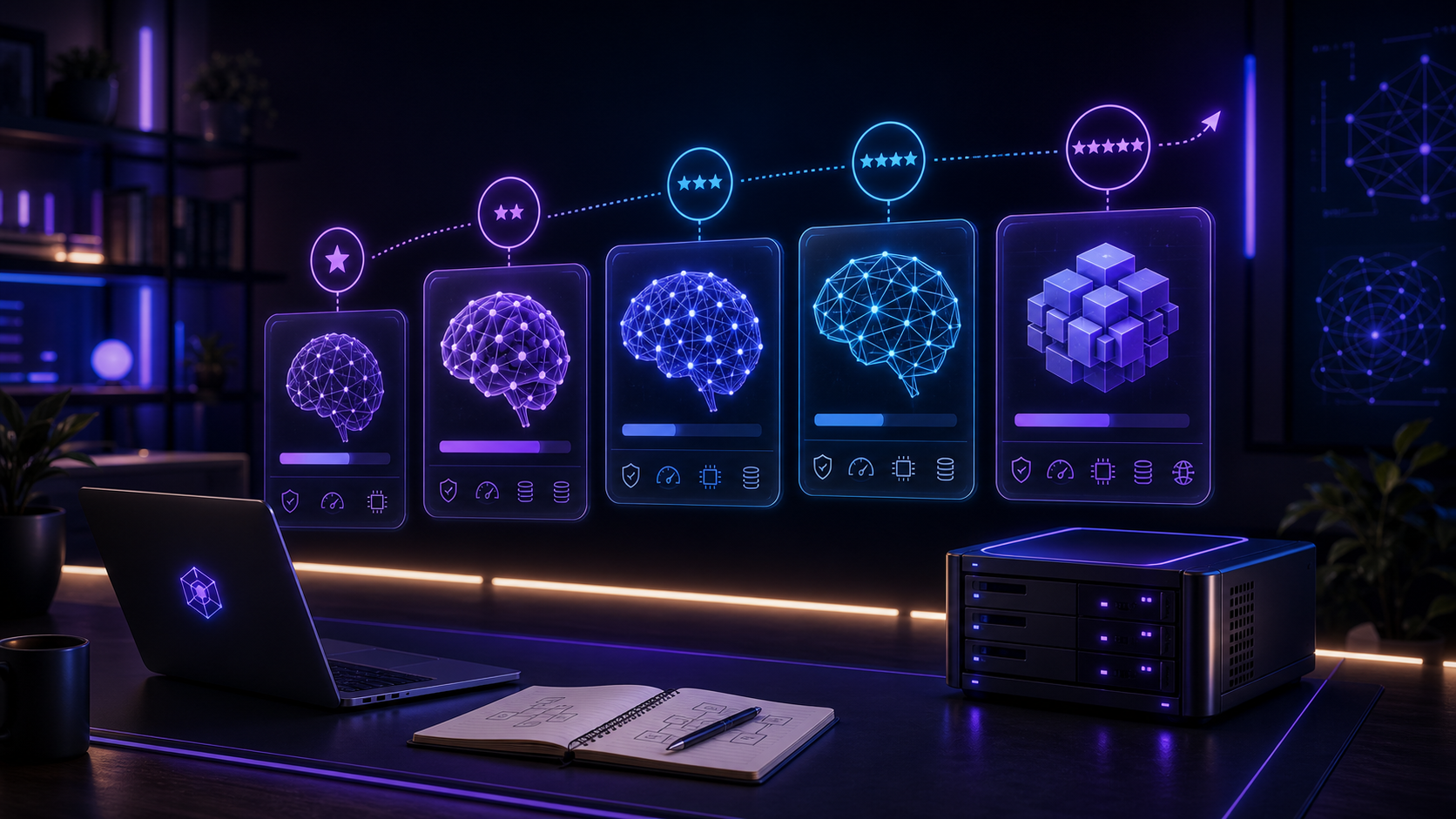
Phi-4 is built on the idea that model quality is not purely a function of parameter count. By training on high-quality synthetic data and carefully filtered web content, Microsoft created a model that punches well above its weight class.
This matters for self-hosted AI because it means you do not always need a 70B model to get useful results. A well-trained 14B model running on a single GPU can handle many tasks that previously required much larger deployments.
If you are deciding between model sizes, How to Choose the Right Local Model Size provides a framework for matching models to real workloads.
Hardware footprint
Phi-4 runs comfortably on hardware that would struggle with most 30B+ models.
Minimum requirements
A 7B or 14B Phi-4 variant in Q4 quantisation fits into 6-10 GB of VRAM. That puts it within reach of mid-range consumer GPUs and even some integrated graphics with enough system RAM.
Recommended setup
For interactive use, a GPU with 12 GB of VRAM gives you room for the Phi-4-14B variant with a reasonable context window. Add 16-32 GB of system RAM for supporting services like the inference server and any vector database you pair with it.
For hardware buying advice, start with Best Hardware for Self-Hosted AI.
Installation options
Ollama
Phi-4 variants are available through Ollama's model library. Pull the size and quantisation that matches your hardware, and you are running within minutes.
Direct GGUF deployment
For more control over inference parameters, download a GGUF version of Phi-4 and run it with llama.cpp or a compatible launcher like LM Studio.
See Ollama vs LM Studio vs TabbyAPI: Choosing the Right Local Model Runner for a comparison of runtimes.
Where Phi-4 excels
Code generation and explanation
Phi-4 performs strongly on coding benchmarks relative to its size. It is useful for explaining code snippets, generating boilerplate, and reviewing small to medium functions.
Instruction following
The synthetic training data gives Phi-4 reliable instruction-following behaviour. It handles structured output formats, multi-step instructions, and nuanced constraints well.
Document summarisation
For summarising articles, meeting notes, and reports, Phi-4 produces concise and accurate results that compare favourably with much larger models.
Limitations to be aware of
Phi-4 is not designed for every task. Its smaller size means it can struggle with highly specialised domain knowledge, very long context reasoning, and tasks that require broad world knowledge. Know where to use it and where to reach for a larger model.
Conclusion
Phi-4 proves that small models can be genuinely useful for self-hosted AI. If you are constrained by hardware or want to run multiple model instances on a single machine, Phi-4 is one of the best options available.
FAQ
Is Phi-4 better than Llama 3.2?
For many instruction-following tasks at comparable sizes, Phi-4 is competitive or better. For general world knowledge and creative tasks, Llama may still have an edge.
Can Phi-4 run on a Raspberry Pi?
Only the smallest variants, and expect very slow inference. A mini PC with a modest GPU is a more practical starting point.
Does Phi-4 support function calling?
It can follow structured output instructions reliably, but dedicated function-calling tuning may be needed for complex tool-use scenarios.