Tutorials
Open WebUI Setup for Local Documents
Turn Open WebUI into a practical document chat layer for PDFs, notes, and private knowledge bases.
Open WebUI Setup for Local Documents
Open WebUI is most useful when it is connected to the documents you already care about. With a clean local setup, it can become a private chat surface for manuals, notes, project files, and knowledge bases without sending data to a third party.
Start with a stable model runtime
Before configuring document chat, make sure your Ollama backend is already working reliably. If you have not done that yet, begin with How to Run Llama 3 Locally with Ollama.
Organise your document sources
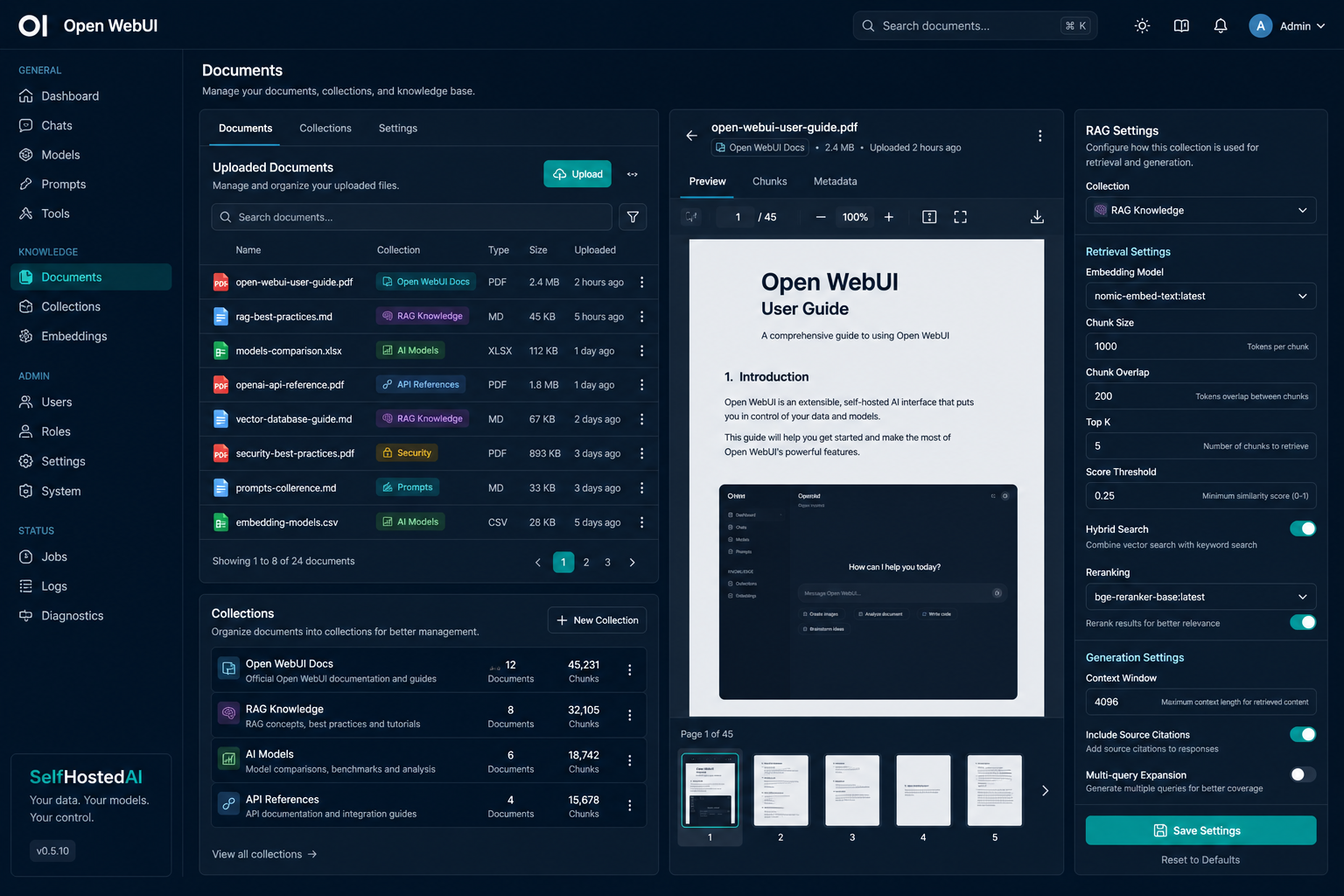
Group files by project or topic before ingesting them. A small number of tidy collections is easier to query than one giant pile of mixed documents. Use consistent filenames and remove duplicate versions where possible.
Keep access boundaries clear
If different people need different document scopes, separate them early. This matters even more once you begin exposing the interface to a team.
Make retrieval feel predictable
Document chat works best when the system can explain where answers came from. Tune chunking, metadata, and source selection so the model can quote the right part of the right file.
For a broader UI comparison, see Open WebUI vs AnythingLLM.
Refine the chat experience
Good document chat is not only about the index. Add helpful instructions, clear conversation titles, and simple prompt templates so users know how to ask for evidence, summaries, or extracted action items.
Conclusion
Open WebUI becomes much more valuable once local documents are part of the workflow. Keep the setup simple, keep the sources organised, and test questions against real files instead of toy examples.
FAQ
What kind of documents work best?
Text-heavy PDFs, markdown notes, manuals, and internal documentation usually work well.
Should I ingest everything at once?
No. Start with one useful folder, verify retrieval quality, then expand in stages.
Do I need another tool for embeddings?
Often yes. Embeddings are usually handled by a separate local model or service, depending on your stack.