Tutorials
Prompt Tuning for Local LLMs Without Overcomplicating Things
Use better prompts, roles, examples, and constraints to improve local model output quickly.
Prompt Tuning for Local LLMs Without Overcomplicating Things
Prompt tuning is mostly about clarity. Local models are often capable enough, but they need tighter instructions than a human would use in a casual conversation.
Use a consistent prompt shape
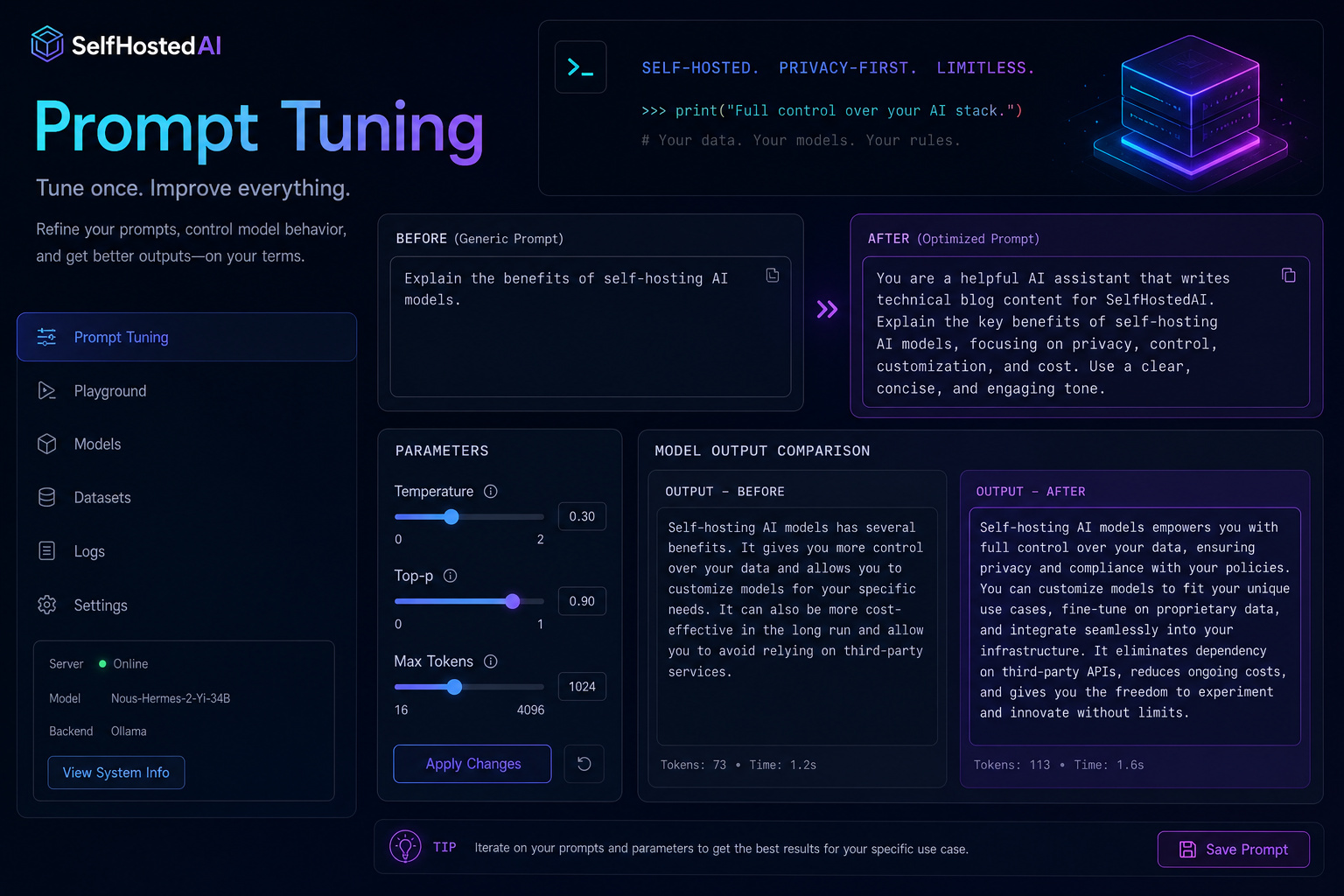
Start with role, task, constraints, and output format. That structure gives the model a clear path and makes it easier to compare prompt versions over time.
If you are still choosing a model, revisit Best Local AI Models for Beginners.
Add examples sparingly
Examples can improve output quality, but too many examples turn prompts into clutter. Use one or two strong examples that match the task instead of a long pile of edge cases.
Prefer instructions over hints
Explicit instructions usually work better than vague encouragement. Tell the model what to do, what not to do, and how the result should look.
Tune for the interface
The same prompt may behave differently in a chat UI, an automation pipeline, or a document assistant. If you are using Open WebUI, test the prompt in the same environment where people will use it.
Read Open WebUI vs AnythingLLM if you are deciding where the prompt layer should live.
Conclusion
Prompt tuning is a practical craft, not a ritual. Keep prompts simple, test them against real tasks, and only add complexity when the result clearly improves.
FAQ
Do local models need more prompt tuning?
Often yes. Smaller and mid-sized models benefit from clearer structure.
Should I save prompt templates?
Absolutely. Treat them as reusable configuration, not throwaway text.
Is few-shot prompting always better?
No. Sometimes a precise instruction works better than examples.