Tutorials
Five Prompt Patterns That Fix the Most Common Local AI Frustrations
Fix vague answers, ignored instructions, and inconsistent output with five practical prompt patterns for local LLMs.
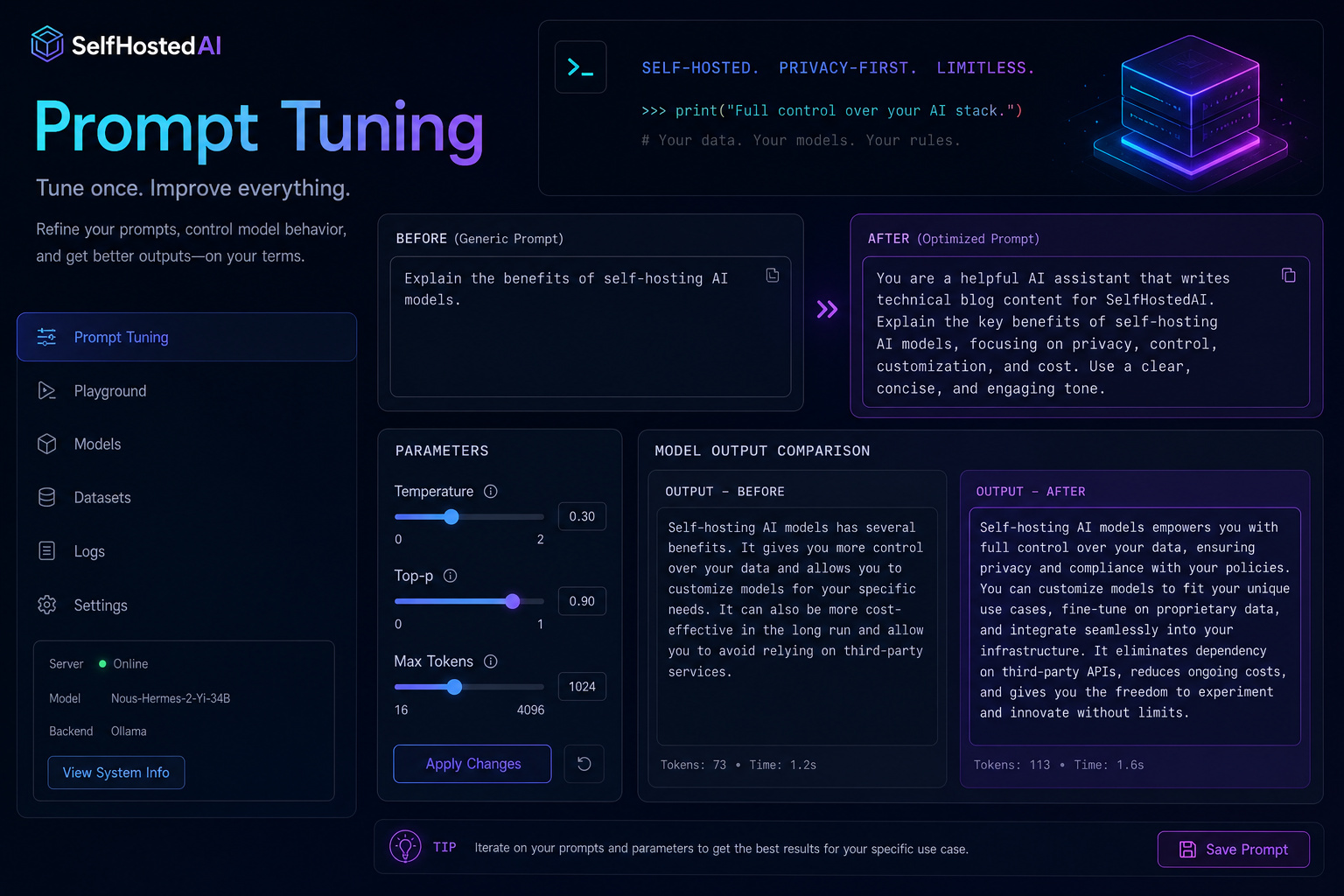
Five Prompt Patterns That Fix the Most Common Local AI Frustrations
Local models are capable, but they are also less forgiving than frontier cloud models. A prompt that works well on GPT-4o may produce rambling, evasive, or contradictory output on a 7B local model. The difference is rarely the model's potential — it is usually the prompt shape.
Pattern 1: The output-first frame
Tell the model what the output should look like before anything else. This pattern works because local models latch onto structural cues earlier in the prompt.
Instead of: "Analyse this customer feedback and tell me what you think."
Use: "Produce a table with columns for issue, frequency, severity, and recommendation. Here is the feedback to analyse: ..."
This pattern pairs well with reusable templates. See Practical Prompt Templates for Research, Summarisation, and Drafting for ready-made structures.
Pattern 2: The negative constraint
Local models benefit from explicit prohibitions. Saying what not to do is often more effective than hoping the model avoids common pitfalls.
Examples: "Do not use bullet points." "Do not mention alternatives." "Do not speculate beyond the provided context." "Do not include a disclaimer."
Be specific. "Keep it short" is too vague. "Write exactly three sentences" is measurable.
Pattern 3: The single-turn anchor
Local models can lose track of multi-turn conversations faster than frontier models. When you want a reliable answer, include all necessary context in one prompt rather than building it across several exchanges.
This is especially important when working with documents. Read Build a Local RAG Pipeline That Actually Answers Questions for how to structure retrieval-augmented prompts that work as single-turn queries.
Pattern 4: The role and audience sandwich
Small models perform better when they know both who they are and who they are speaking to. Sandwich the role and audience around the instruction:
"You are a senior developer reviewing a pull request. Your audience is a junior developer who needs clear, actionable feedback. For each issue found, state the file, the problem, and the fix in that order."
This pattern cuts rambling by roughly half in most local models.
Pattern 5: The verification closing
End every instruction prompt with a verification step: "After you write the answer, check whether it addresses all the points in the instruction. If it does not, add the missing parts."
This metacognitive nudge helps smaller models compensate for weaker attention mechanisms. It is simple, takes no extra API calls, and measurably reduces omissions.
Putting the patterns together
The most effective prompts combine two or three of these patterns. A research prompt might use the output-first frame for structure, the single-turn anchor to keep context compact, and the verification closing to catch omissions.
For a deeper look at the underlying techniques, revisit Prompt Tuning for Local LLMs Without Overcomplicating Things.
Conclusion
Fixating on model size is easy, but prompt pattern discipline often delivers bigger improvements for free. Try these five patterns on your most-used prompts and measure the difference yourself.
FAQ
Why do local models need stricter prompts?
Local models have smaller parameter counts and less emergent instruction-following ability, so they benefit from clearer structure.
Should I use all five patterns together?
Not always. Pick the patterns that address the specific failure mode you are seeing.
Do these patterns work on cloud models too?
Yes, though cloud models may tolerate looser structure. The patterns never hurt on any model.