Tutorials
Open WebUI Advanced Features: RAG, Web Search, and Image Generation
Go beyond basic chat with Open WebUI's RAG pipelines, web search integration, image generation, and multi-model workspaces.
Open WebUI Advanced Features: RAG, Web Search, and Image Generation
Open WebUI is one of the most feature-rich interfaces for local AI chat, and most users only scratch the surface. Beyond the basic chat window, there are document pipelines, web search tools, image generation, model routing, and a growing ecosystem of integrations that turn a simple chat front end into a capable self-hosted AI workstation.
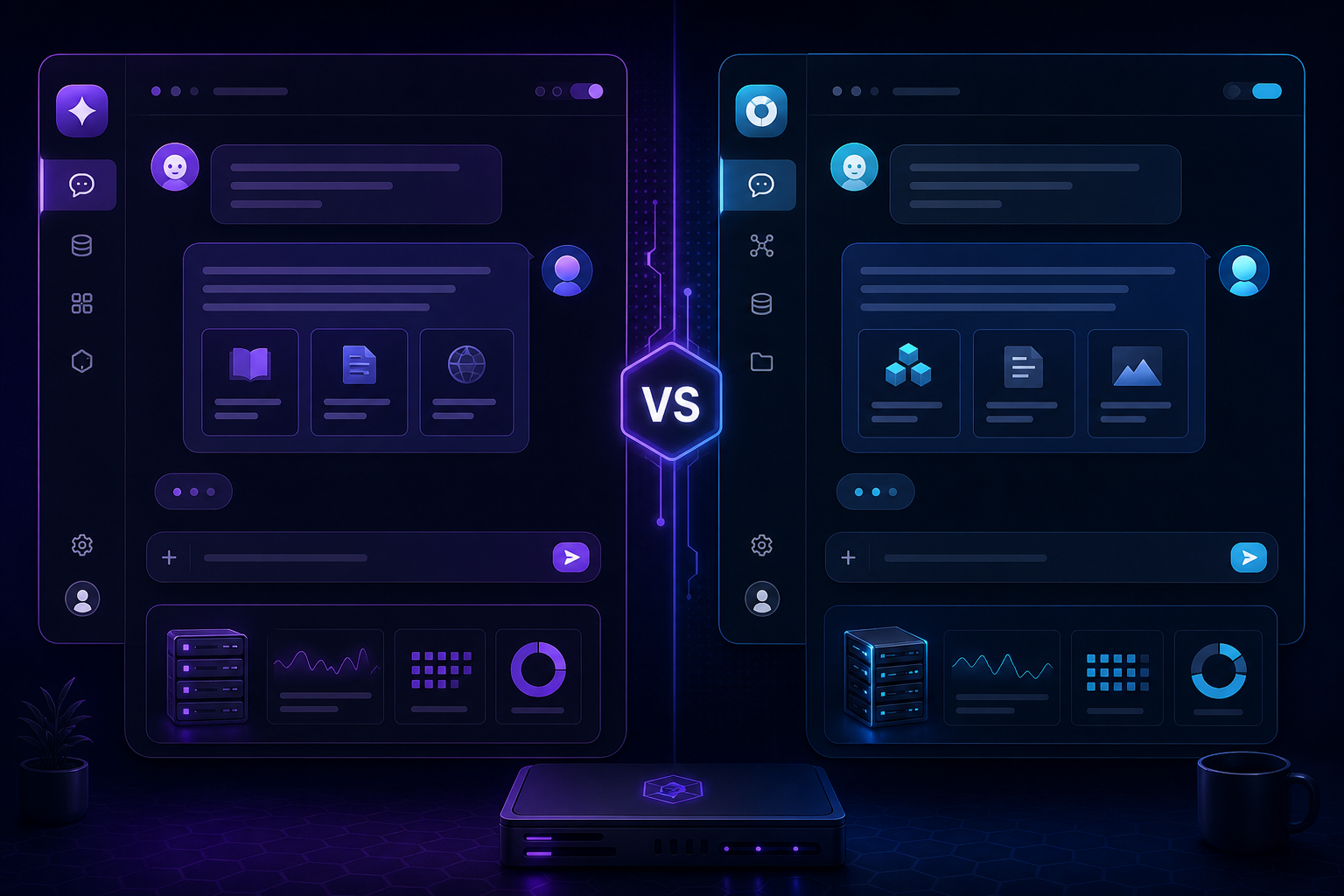
If you are new to Open WebUI, start with the setup covered in Open WebUI vs AnythingLLM to understand how it fits into your stack.
Document RAG pipelines
Open WebUI supports file uploads and retrieval-augmented generation through its built-in document pipeline. You can upload PDFs, text files, Markdown, and code files directly into a conversation, and the system chunks, embeds, and indexes them on the fly.
For deeper document workflows, adjust chunk size and overlap in the admin settings. Smaller chunks improve precision on narrow questions; larger chunks help with summarisation. Pair this with a local embedding model to keep everything private.
To build a dedicated document workflow, see Create an Internal Knowledge Assistant with Open WebUI and Ollama.
Web search integration
Open WebUI can search the web and feed results into the model's context. Enable this in the admin panel under Web Search, configure a search API endpoint, and the interface adds a search tool that runs before the model generates its answer.
This is useful whenever the model needs current information, documentation, or facts outside its training data. The web search step runs automatically when the model detects it needs external context.
Image generation with local models
If you have a compatible image generation model or service running alongside your chat models, Open WebUI can route image generation requests through the same interface. Enable the image generation feature in admin settings and point it at your generation endpoint.
This keeps creative workflows inside the same tool instead of switching between separate applications for text and image generation.
Model routing and workspaces
Open WebUI supports connecting multiple model backends at the same time. You can route chat to a fast small model, route document queries to a retrieval-tuned model, and keep image generation on a separate endpoint — all from the same interface.
Workspaces let you organise conversations, documents, and tools by project or team, which is especially valuable when multiple people share the same instance.
Authentication and user management
For shared deployments, Open WebUI includes built-in user authentication, role-based access, and session management. You can enable self-registration, set up admin accounts, and control who can access specific models or tools.
Read How to Secure a Self-Hosted AI Server before opening your instance to a team.
Conclusion
Open WebUI's advanced features turn a simple chat interface into a capable self-hosted AI platform. Start with the basics, then enable document RAG and web search as your workflows grow more complex. The modular design means you can add capabilities without rebuilding the stack.
FAQ
Does Open WebUI store my documents?
Documents are stored locally in the database. You can delete upload history from the admin panel.
Can I use Open WebUI without Ollama?
Yes. Open WebUI supports any OpenAI-compatible API endpoint, including LM Studio, TabbyAPI, and cloud providers.
Is image generation available for all models?
No. Image generation requires a compatible model or endpoint configured separately from the chat model.