Tutorials
Open WebUI Workspaces for Team Document Collaboration
Set up multiple Open WebUI workspaces so different teams share models but keep their documents, prompts, and chat histories separate.

Open WebUI Workspaces for Team Document Collaboration
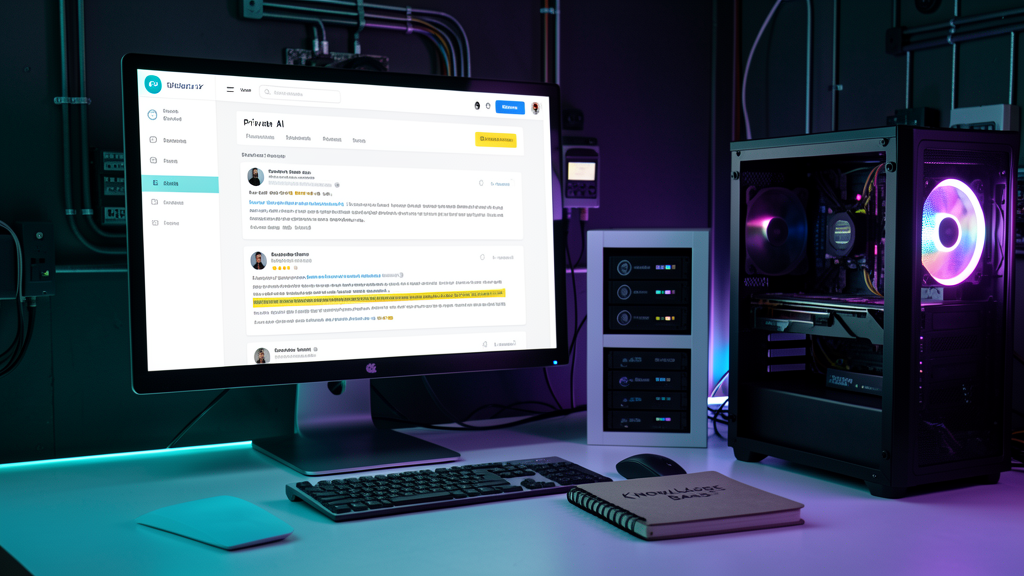
When a single Open WebUI instance serves multiple teams or projects, workspaces give each group its own document collections, model preferences, and prompt libraries while sharing the same infrastructure. Workspaces prevent the chaos of everyone's uploaded documents mingling in one bucket and make it practical to run one server for an entire organisation.
Why Workspaces Matter for Teams
A single chat interface without workspace isolation works fine for an individual. As soon as a second person starts uploading documents, the retrieval pool becomes a soup of unrelated content. A sales team's contracts mix with engineering's technical specs, and retrieval quality drops for everyone.
Workspaces solve this by giving each group its own document store, knowledge base, and configuration — all within one Open WebUI deployment.
If you are new to Open WebUI, start with How to Add Local Documents to Open WebUI with RAG before adding workspace complexity.
How Open WebUI Workspaces Work
Open WebUI organises its workspace feature around three concepts:
| Concept | Purpose |
|---------|---------|
| **Workspace** | Isolated environment with its own documents, models, and prompts |
| **Knowledge base** | Document collection tied to a workspace, used for RAG queries |
| **Model assignment** | Default models and model visibility scoped to each workspace |
Each workspace behaves like a separate Open WebUI instance for the people assigned to it. Switching workspaces changes which documents the RAG system searches, which models are available, and which prompt templates appear.
Setting Up Workspaces
Step 1: Enable workspace support
Open WebUI's workspace feature is available in recent builds. Check you are running a current version:
```bash
docker pull ghcr.io/open-webui/open-webui:main
```
Verify the workspace menu appears in the top-left corner of the interface after restart.
Step 2: Create your first workspace
Navigate to **Settings -> Workspaces** and create a new workspace with a descriptive name, for example "Engineering" or "Sales Enablement". Each workspace can have its own description so users know its purpose at a glance.
Step 3: Assign models
Each workspace can restrict which models appear. For example, the Engineering workspace might default to DeepSeek V4 Pro for reasoning tasks, while the Support workspace uses a faster model like Qwen 3 8B for quick answers. See Choosing the Right Local Model Size for guidance on matching models to workloads.
Step 4: Upload workspace-specific documents
Documents uploaded inside a workspace are only visible to that workspace's RAG system. This is where the real value appears — engineering knows their API docs are separate from sales materials.
```bash
Documents are uploaded through the Open WebUI interface
Select the workspace first, then use the document upload in the workspace panel
```
Step 5: Configure workspace prompts
Save prompt templates per workspace. Engineering might have code review and architecture analysis prompts, while Marketing has content brief and headline generation templates.
Multi-User Access with Workspaces
Workspaces combine with Open WebUI's user management to control who sees what:
- **Admins** see all workspaces
- **Regular users** join specific workspaces through invitations or admin assignment
- **Guest users** can be limited to a single workspace
For complete user management guidance, see How to Configure Open WebUI for Multi-User Access.
Practical Team Workflows
Engineering team
- **Documents:** API specifications, architecture decision records, code style guides, onboarding manuals
- **Default model:** DeepSeek V4 Pro or Llama 3.1 70B for reasoning-heavy tasks
- **Prompts:** Code review templates, architecture analysis, dependency audit checklists
Customer support team
- **Documents:** Product documentation, FAQ databases, escalation procedures, ticket templates
- **Default model:** Qwen 3 8B or Gemma 3 for fast, concise answers
- **Prompts:** Ticket categorisation, response drafting, knowledge base search
Content team
- **Documents:** Brand guidelines, editorial calendars, style guides, competitor analyses
- **Default model:** GPT-OSS-20B or Llama 3.1 for creative and drafting work
- **Prompts:** Blog post outlines, headline variants, SEO optimisation
Backing Up Workspaces
Each workspace's data is stored in Open WebUI's underlying database. Back up the entire database regularly:
```bash
Open WebUI uses SQLite by default
cp /path/to/open-webui/data/webui.db /backup/location/webui-$(date +%Y%m%d).db
```
For Docker deployments, use volume backups. See Docker Setup for Local AI Tools for data persistence best practices.
Troubleshooting Workspace Issues
Documents not appearing in a workspace
Confirm you uploaded the documents while the correct workspace was selected. Switch to the workspace first, then upload.
Models missing from workspace
Check the workspace's model assignment settings. Only models explicitly assigned to a workspace appear in its model selector.
User cannot see workspace
Verify the user has been added to the workspace in Admin -> Users -> Edit User -> Workspace Assignments.
Conclusion
Open WebUI workspaces transform a single chat instance into a multi-team knowledge platform. Documents stay where they belong, models match the job, and prompt templates accumulate relevant experience per group. Start with two workspaces — one for your team and one for testing — then expand as collaboration patterns emerge.
FAQ
Can one user belong to multiple workspaces?
Yes. Users can switch between workspaces they have been assigned to through the workspace selector.
Do workspaces share the same Ollama backend?
Yes. Workspaces are an Open WebUI organisational layer — they share the same Ollama or model backend that Open WebUI connects to.
Are workspace document collections separate databases?
No, they are logically separated within the same Open WebUI database. Documents uploaded in one workspace are only retrievable from that workspace.
**Sources:**